Accepted May 2024
An ethanol plant
Air terminals on the distillation columns and a molasses tank, with welded grounding. Passed the 10-ohm limit.
Case study · Lightning Protection
Sugar mill and cogeneration plant
Two protected areas, six ground rods
Negros Occidental, Philippines
A sugar mill and cogeneration plant in Negros Occidental engaged LMI to protect two high points of the plant from lightning: an area on a conveyor structure and a boiler chimney.
LMI installed air terminals, strike counters and welded grounding in six days, and every ground rod tested well under one ohm.
On recordSigned acceptance test, completion report and certificate, March 2026.
Identified the two high points to protect and planned the grounding.
Mounted the air terminals and strike counters, and ran copper conductors in conduit.
Drove six ground rods in hand-holes and joined them by exothermic welding.
Measured each rod's earth resistance, then a signed acceptance test.
Site challenge
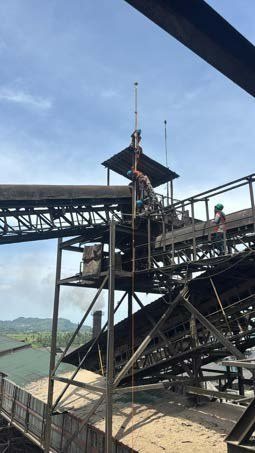
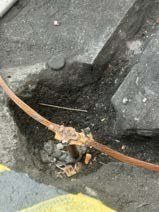
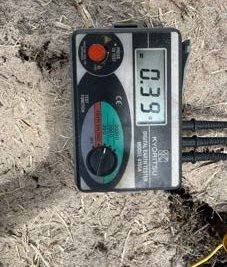
Mounting at height, a welded ground joint, and an earth-resistance reading of 0.39 ohm.
On recordAcceptance test signed by the plant's representative. Overall result: Passed.
Accepted May 2024
Air terminals on the distillation columns and a molasses tank, with welded grounding. Passed the 10-ohm limit.
Accepted November 2025
Two pole-mounted arresters covering seven plant buildings, measured at 0.18 and 0.26 ohm.
Digital transformation requires solid infrastructure.
Every new system depends on the infrastructure beneath it. LMI builds that foundation so your team can find it, maintain it and trust it.
Air terminals and low-resistance grounding give lightning a safe path down.
ProofSix rods, all under one ohm.
Every ground rod is tested, and the readings are recorded at handover.
ProofSix readings recorded, 0.31–0.73 ohm.
Strike counters record each lightning event on the protected structures.
ProofTwo strike counters installed.
Your team signs the acceptance test before the system is relied on.
ProofSigned acceptance, March 2026.
Also from LMIThe rest of the infrastructure a digital operation runs on: Network refresh · Fiber optic cabling · Structured copper cabling · Core switching · Managed firewall and Wi-Fi · Managed CCTV · Access control and turnstiles · Electrical works · Turnkey infrastructure projects
Is your plant protected for the next storm? Start with a survey.
Contact us at lori@onelmi.comClient and site names withheld. Product names are trademarks of their owners.
LMI Corporation · Bacolod City, Negros Occidental, Philippines